There is a certain magic to train journeys that other forms of travel simply cannot replicate. It is a slower, more deliberate way to move through a landscape, a rolling theatre where the world outside your window is the main performance. In an age of frantic airport dashes and impersonal highway miles, the train offers a return to romance, to connection, and to the sheer joy of the journey itself. Within the vast and varied tapestry of China, this romance is amplified tenfold, offering a unique portal into the soul of the country.
China’s railway network is a marvel of modern engineering, a sprawling web that connects bustling megacities with remote, ancient villages, skyscraper forests with endless grasslands, and humid southern coasts with the arid deserts of the west. But beyond its sheer utility, certain routes have earned legendary status for their breathtaking scenery. These are not merely modes of transport; they are destination experiences in their own right. To embark on one is to purchase a ticket for a moving panorama, a continuously unfolding scroll painting of China’s most dramatic and beautiful terrain.
The journey from Xining to Lhasa aboard the Qinghai-Tibet Railway is arguably one of the most epic train trips on the planet. This is not hyperbole. As the train climbs onto the roof of the world, it traverses landscapes that feel almost otherworldly. The initial hours reveal the stark, powerful beauty of the Qinghai plateau, with its giant salt lakes shimmering under an immense sky. But the true magic begins as you approach and then cross the Tanggula Pass, the highest point of any railway in the world. Here, at over 5,000 meters above sea level, you are literally on top of the world, surrounded by snow-capped peaks and vast, empty plains where yaks and Tibetan antelope roam. The train is specially equipped with oxygen supplies to ensure passenger comfort, making this awe-inspiring journey accessible to all. The sight of the pristine Yamdrok Lake and the first glimpse of the Potala Palace in the distance are moments that will be seared into your memory forever.
For a completely different, yet equally magnificent, experience, the line from Beijing to Zhangjiajie offers a journey from imperial history into a realm of fantasy. Departing the capital, you watch the North China Plain gradually give way to rolling hills and then to the dramatic karst formations of Hunan province. The climax of the trip is the approach to the Wulingyuan Scenic Area, a UNESCO World Heritage Site. The train navigates through a forest of towering sandstone pillars, mist-shrouded peaks, and deep ravines that inspired the floating Hallelujah Mountains in the film Avatar. It’s a surreal and humbling landscape that appears plucked from a dream.
If tropical vistas and coastal views are more your style, the high-speed route along the Hainan Eastern Ring Railway is a sun-drenched delight. Circling the island paradise of Hainan, this line offers uninterrupted views of azure waters, golden beaches, and lush coconut plantations. It’s a journey of light and blue, where the South China Sea is your constant companion. The contrast between the modern comfort of the train and the timeless beauty of the landscape creates a uniquely relaxing and uplifting travel experience.
Choosing the right seat is paramount to maximizing these visual feasts. This is not a mere logistical detail; it is the difference between watching the show and having a front-row seat. The cardinal rule for scenic routes is simple: know the direction of travel and the position of the sun. For the most part, you will want to be on the side of the train that faces the main attraction, which often avoids the harsh glare of the sun for better photography and viewing.
On the Qinghai-Tibet Railway heading from Xining to Lhasa, the most spectacular scenery—including the Tanggula Mountains and the Tsonag Lake—unfolds primarily on the right-hand side of the train. Securing a window seat on this side is the golden ticket. Conversely, for the Beijing to Zhangjiajie route, the fantastical karst pinnacles are best viewed from the left-hand side when traveling southbound. The Hainan Eastern Ring Railway, being a coastal loop, offers stunning ocean views on both sides, but the right-hand side when traveling clockwise from Haikou to Sanya generally provides the most consistent and open vistas of the sea.
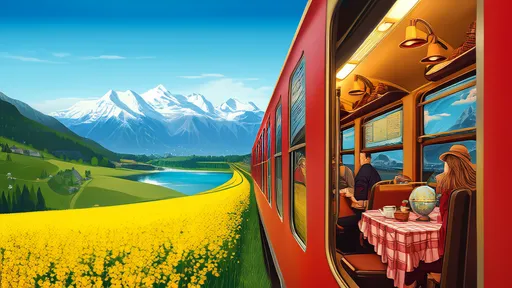
Beyond picking a side, the type of seat matters. While first-class offers more legroom and wider seats, a second-class window seat often provides an equally good, if not better, view. The windows are just as large. For the ultimate experience, however, consider the soft sleeper compartments on overnight scenic journeys. Having a private window to your own moving postcard, from which you can watch the sunset over the mountains and wake up to an entirely new world, is the pinnacle of train travel romance. If available, a seat in the dining car or observation car (on certain newer trains) can also provide a fantastic, social vantage point for enjoying the scenery.
The romance of the rails is a tangible thing. It’s in the gentle rhythm of the wheels on the tracks, a soothing soundtrack to your adventure. It’s in the fleeting connections made with fellow travelers over a shared thermos of tea, united in wonder at the landscape rushing by. It’s in the freedom to get up and walk around, to find a new perspective in the space between carriages, or to simply sit and be present as China reveals its secrets mile by majestic mile.
In a country so vast and diverse, the train is more than a convenience; it is a narrative device. It tells the story of the land, from the geological upheavals that created its mountains to the human ingenuity that now traverses them. To travel by train in China is to become a part of that story. So, book your ticket, choose your window seat wisely, and prepare to be moved—not just from one destination to another, but in your very soul. The landscape is waiting to perform for you.
By /Aug 22, 2025

By /Aug 22, 2025
By /Aug 22, 2025

By /Aug 22, 2025
By /Aug 22, 2025
By /Aug 22, 2025

By /Aug 22, 2025

By /Aug 22, 2025
By /Aug 22, 2025
By /Aug 22, 2025

By /Aug 22, 2025

By /Aug 22, 2025

By /Aug 22, 2025

By /Aug 22, 2025
By /Aug 22, 2025
By /Aug 22, 2025
By /Aug 22, 2025

By /Aug 22, 2025

By /Aug 22, 2025
By /Aug 22, 2025
