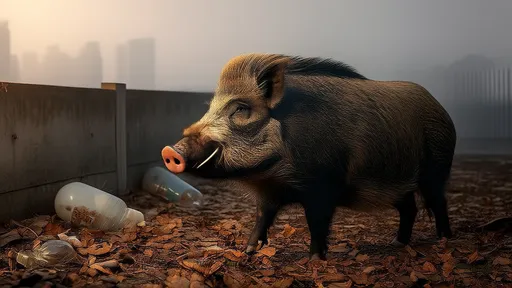
In the shadow of skyscrapers and the hum of urban life, an unlikely survivor thrives with remarkable tenacity. The wild boar, once confined to deep forests and rural landscapes, has emerged as a master of adaptation along the fringes of our cities. These robust creatures navigate a world of concrete and green patches with a cunning that baffles ecologists and unsettles residents. Their story is not one of simple invasion, but a complex tale of resilience, intelligence, and an almost eerie ability to turn human development to their advantage. They are the uninvited guests at our urban picnic, and they are here to stay.
The journey of the wild boar from forest dweller to urban edge specialist is a testament to its incredible biological and behavioral plasticity. Unlike many species that wither in the face of human expansion, the boar has pivoted, finding new opportunities where others found only extinction. Their omnivorous diet, once consisting of roots, tubers, small animals, and carrion in the wild, has expanded to include a spectacular array of urban offerings. From overturned garbage bins and compost heaps to ornamental gardens and agricultural leftovers, they have become gourmets of our waste. This dietary flexibility provides a constant, rich food source that often surpasses the unpredictable bounty of nature, supporting larger and healthier populations than many natural habitats could sustain.
Their physical robustness is the foundation of this success. Equipped with a powerful, low-slung body and a formidable snout capable of overturning turf and even cracking open lightweight paving, the boar is a built-in excavation tool. This allows them to access buried food sources, create wallows for temperature regulation, and dig out secure resting spots in greenbelts, parks, and overgrown lots. Their coarse, bristly fur provides insulation against both the chill of winter and the summer heat, making them indifferent to seasonal shifts that challenge other animals. Furthermore, they possess a keen sense of smell, estimated to be far superior to that of a domestic dog, which allows them to detect food sources buried underground or sealed within flimsy containers from impressive distances.
Perhaps their most significant adaptive trait is their reproductive strategy. Sows can produce large litters, often with more than six piglets, and can breed more than once a year when conditions are favorable—which the constant banquet of the urban edge certainly provides. This high reproductive rate allows their populations to rebound quickly from culls or harsh conditions and to expand into new territories at an astonishing pace. The young learn the ways of urban survival quickly from their mothers, forming sounders (family groups) that expertly navigate the labyrinth of suburbs, avoiding major threats and capitalizing on predictable human patterns, like trash collection schedules.
Behaviorally, the wild boar has undergone a quiet revolution. They have largely shifted their activity patterns to become creatures of the night and twilight—crepuscular and nocturnal—to minimize encounters with humans. Under the cover of darkness, they move with surprising stealth through neighborhoods, golf courses, and rail corridors. They have developed a sophisticated understanding of which humans pose a threat and which are indifferent, often displaying a calculated wariness rather than blind fear. This learned behavior reduces conflict and energy expenditure, allowing them to forage efficiently while the city sleeps.
The urban landscape itself, often decried for its hostility to wildlife, has become a fortress of sorts for the boar. The patchwork of green spaces—from overgrown riverbanks and transport verges to large parks and abandoned industrial sites—provides perfect corridors for movement and hiding. These areas offer shelter, breeding grounds, and respite from the harshest elements of the city. For an animal as intelligent and opportunistic as the boar, this mosaic does not represent fragmentation but a network of opportunity. They use drainage culverts to pass under busy roads and learn the schedules of park maintenance crews to avoid them, demonstrating a level of spatial and temporal awareness that is deeply impressive.
This adaptation, however, is not without its consequences and conflicts. Their rooting behavior can devastate lawns, sports fields, and culturally significant green spaces, leading to significant economic costs for municipalities. They are involved in an increasing number of traffic accidents, posing a danger to both themselves and motorists. While generally wary of people, encounters can turn aggressive, particularly if a sow feels her piglets are threatened. Their presence also raises concerns about disease transmission, both to domestic livestock and, in rare cases, to humans. Managing these conflicts has become a major challenge for city planners and wildlife officials, who struggle to balance public safety with ethical wildlife management practices.
Efforts to control urban boar populations have met with limited success. Traditional hunting is often impractical and unsafe in densely populated areas. Trapping and relocation are expensive, logistically challenging, and often simply move the problem elsewhere. Fertility control, while a promising avenue, is still in its experimental stages for widespread application. The boar's high intelligence allows them to quickly learn to avoid traps and other control measures, making any management strategy a game of constant adaptation on both sides. In many ways, our attempts to control them only serve to further demonstrate their remarkable ability to overcome challenges.
The story of the wild boar at the urban edge is a powerful lesson in ecology and evolution happening in real-time right before our eyes. It is a narrative that forces us to reconsider the boundaries between wild and urban, natural and artificial. They are not merely pests; they are a reflection of our own impact on the planet and a stunning example of a species that is not just surviving but thriving in the new worlds we create. Their success is a humbling reminder that nature is not always pushed back; sometimes, it adapts, pushes forward, and finds a way to claim a piece of the world we thought was ours alone.
As cities continue to expand and natural habitats shrink, the relationship between humans and species like the wild boar will only become more complex. They are the ultimate generalists in a world we are making for specialists. Understanding their adaptability is the first step towards developing more sophisticated and co-existent relationships with the wildlife on our doorsteps. The boar, with its grunt and its rooted-up flowerbeds, is here to teach us that the edge is not a barrier but a new ecosystem, and it has already graduated at the top of its class.
By /Aug 21, 2025
By /Aug 21, 2025
By /Aug 21, 2025
By /Aug 21, 2025
By /Aug 21, 2025
By /Aug 21, 2025
By /Aug 21, 2025
By /Aug 21, 2025
By /Aug 21, 2025
By /Aug 21, 2025
By /Aug 21, 2025
By /Aug 21, 2025
By /Aug 21, 2025
By /Aug 21, 2025
By /Aug 21, 2025
By /Aug 21, 2025

By /Aug 21, 2025
By /Aug 21, 2025
By /Aug 21, 2025
By /Aug 21, 2025
