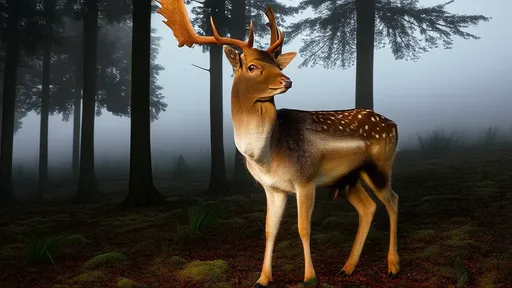
In the quiet heart of the forest, where shadows dance and leaves whisper, there exists a master of vigilance, an unsung sentinel of the wild—the deer. To the casual observer, it may appear as just another graceful creature, a fleeting glimpse of brown and white amidst the trees. But to those who understand the intricate language of the woods, the deer is far more: it is nature's most sophisticated early warning system, a living, breathing alarm that speaks of danger long before human senses can perceive it.
This remarkable ability is not born of mere chance; it is the product of millions of years of evolution, fine-tuned by the relentless pressures of survival. From the sprawling deciduous forests of North America to the dense woodlands of Europe and Asia, deer have honed their skills to near perfection. Their survival depends on an acute awareness of their surroundings, an awareness that extends beyond their own needs to benefit the entire ecosystem. They are the forest's guardians, their every twitch and flicker a message in a code written by time itself.
At the core of this system are the deer's extraordinary senses, each a marvel of biological engineering. Their large, laterally placed eyes provide a panoramic field of vision, spanning nearly 310 degrees, allowing them to detect movement from almost any direction without turning their heads. This is crucial in an environment where predators can strike from any angle. But their vision is specially adapted for low light; they are crepuscular beings, most active at dawn and dusk, and their eyes contain a high proportion of rod cells and a reflective layer called the tapetum lucidum, which enhances their ability to see in the dim glow of twilight. However, this comes at a cost: they are thought to be dichromats, seeing the world in shades of blue and yellow but struggling with reds and greens, making them excellent motion detectors but poor detail discriminators.
If their eyes are the watchtowers, their ears are the parabolic microphones of the forest. Large, rotatable, and independently controlled, a deer's ears can pivot like radar dishes, pinpointing the faintest rustle of a leaf or the snap of a twig from hundreds of yards away. They can detect a much wider range of frequencies than humans, particularly into the ultrasonic range, allowing them to hear the high-pitched communications of rodents or the stealthy footfalls of a stalking predator that are utterly inaudible to us. Each ear moves independently, triangulating sound with astonishing accuracy, giving the deer a three-dimensional sound map of its environment. The direction in which a deer points its ears is a direct readout of its focus and perceived threat level.
Yet, perhaps their most underrated and powerful sense is smell. A deer's olfactory system is nothing short of phenomenal. Their long snouts are packed with hundreds of millions of scent receptors, a number that dwarfs the human capacity. They don't just smell the air; they read it. They can detect the scent of a predator lingering on a branch hours after it has passed. They can decipher the complex chemical messages in the urine and glandular secretions of other deer, reading information about identity, reproductive status, and dominance. The wind is their greatest ally and their most treacherous foe; they will always position themselves downwind to feed or rest, allowing the breeze to carry the story of the woods directly to them. A single shift in the wind can send them bolting, their white tails flagging a warning to every creature in the vicinity.
But this early warning system is more than the sum of its parts. It is an integrated network of constant analysis and cross-referencing. A sound alone may not trigger flight; but a sound paired with a confirmed scent, or a glimpse of movement against the wind, creates a certainty of danger that demands an immediate response. This cognitive processing happens in an instant, a subconscious calculus of survival honed over a lifetime of alertness. They are not just reacting; they are predicting, interpreting ambiguous signals based on a deep, instinctual knowledge of their home terrain.
The impact of this vigilance extends far beyond the individual deer. The forest itself listens. The sudden, sharp snort of a deer, a explosive exhalation that clears the nasal passages to enhance smelling while signaling high alarm, sends ripples of awareness through the ecosystem. Birds may fall silent. Squirrels may freeze on their trunks. Other deer, perhaps out of sight, will immediately adopt a statuesque posture, their own senses heightened, ready to mirror the flight of the sentinel. This phenomenon, sometimes called the sentinel effect, creates a communal security network. By heeding the deer's alarm, countless other species—from rabbits and birds to even large herbivores like moose—gain precious seconds to escape a shared threat. The deer, often a prey species, becomes a keystone of safety for its biological community.
Human observers, from hunters and naturalists to wildlife ecologists, have long sought to understand and circumvent this system. They learn to move against the wind, to don camouflage that breaks up their human outline, and to practice a silence so profound it becomes a presence in itself. Yet, very often, they are still seen, heard, or smelled first. This eternal game of cat and mouse is a testament to the system's effectiveness. It is a humbling reminder that despite our technology and intellect, there are forms of intelligence and awareness born of wildness that we can only aspire to understand.
In our modern world, where sensory overload is the norm and constant connection dulls our perception of the natural world, the deer stands as a powerful symbol of focused awareness. It challenges us to be still, to listen not just with our ears but with our whole being, to see not just what is in front of us but what lies in the periphery, and to understand that the most critical information is often carried on the wind, whispered in a language older than words. The deer does not just live in the forest; it is the forest's consciousnes, its early warning expert, forever vigilant, forever speaking the ancient truths of survival to those who know how to listen.

By /Aug 21, 2025

By /Aug 21, 2025

By /Aug 21, 2025

By /Aug 21, 2025

By /Aug 21, 2025

By /Aug 21, 2025

By /Aug 21, 2025
By /Aug 21, 2025

By /Aug 21, 2025
By /Aug 21, 2025
By /Aug 21, 2025
By /Aug 21, 2025
By /Aug 21, 2025

By /Aug 21, 2025
By /Aug 21, 2025
By /Aug 21, 2025

By /Aug 21, 2025

By /Aug 21, 2025

By /Aug 21, 2025

By /Aug 21, 2025
