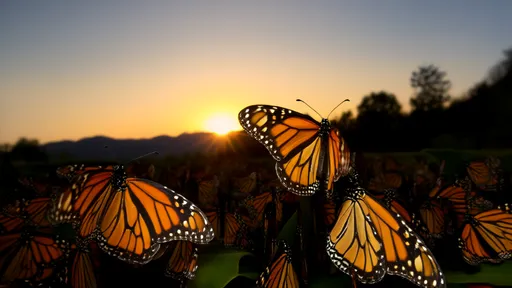
Every autumn, a delicate dance of orange and black descends upon the forests of central Mexico, a spectacle born from one of nature's most profound and fragile journeys. The monarch butterfly, with wings no thicker than a few sheets of paper, embarks on an epic migration spanning thousands of miles—a feat that defies its apparent fragility and continues to mystify scientists and captivate onlookers alike. This annual pilgrimage, a multi-generational relay against staggering odds, represents not just a biological wonder but a poignant narrative of resilience, instinct, and the intricate threads that bind our ecosystem.
The journey begins not with a single butterfly, but with a lineage. The monarchs that flutter into the Mexican oyamel fir forests in late October are the great-great-grandchildren of those that left the very same trees the previous spring. This fourth generation, known as the "Methuselah" generation, is physiologically distinct. Unlike their short-lived parents and grandparents who flitted through northern meadows for mere weeks, these migratory monarchs enter a state of reproductive diapause. Their bodies, supercharged with fat reserves, are built for endurance, not procreation. They are living gliders, designed by evolution for one purpose: to survive the long haul south. It is a strategy of breathtaking complexity, a life cycle orchestrated by an unseen genetic conductor that cues this special generation to be born at precisely the right time with precisely the right biological programming.
The question of how they navigate remains one of the great enigmas of animal behavior. These insects, weighing less than a gram, are celestial navigators. Research has shown they use a sophisticated sun compass situated in their antennae and brain to maintain a south-southwesterly direction. They can compensate for the sun's movement across the sky throughout the day, a cognitive ability once thought to be the exclusive domain of much larger-brained animals. Furthermore, they are suspected of sensing the Earth's magnetic field, using this internal GPS as a backup on cloudy days. This dual-system navigation, fine-tuned over millennia, guides them unerringly to a dozen specific mountain peaks they have never seen, a destination imprinted in their DNA.
The sheer physical toll of the journey is almost incomprehensible. Beating their wings five to twelve times a second, they travel up to 100 miles a day, often riding thermal updrafts to conserve precious energy. They face a gauntlet of perils: predatory birds, paralyzing parasites like the Ophryocystis elektroscirrha protozoan, violent storms, and the ever-present threat of exhaustion. Their survival hinges on a network of waystations—fields of nectar-rich wildflowers and patches of milkweed, their host plant, which are crucial for refueling. The fragility of their wings is a deception; they are marvels of aerodynamic engineering, covered in thousands of microscopic scales that aid in flight and thermoregulation. Yet, a single snapped twig or a hard rain can spell disaster, making their successful arrival a testament to both incredible design and immense luck.
Upon reaching the high-altitude sanctuaries of Michoacán and the State of Mexico, the survivors cluster by the millions on the fir boughs, creating a living tapestry that bends the trees under their collective weight. Here, they enter a state of semi-hibernation, slowing their metabolism to endure the cool winter months. The forest microclimate is critical; too cold, and they freeze; too warm, and they expend their energy reserves prematurely. They remain in this quiescent state until the lengthening days and warming sun of spring trigger the next phase. As February turns to March, the same butterflies that flew south awaken, mate, and begin the northward journey, laying the eggs on milkweed plants in northern Mexico and the southern United States that will become the first generation of the year. They complete the cycle their ancestors began, their own lives ending so that their offspring may continue the relay north.
Today, this ancient ritual is under siege. The monarch migration is now classified as endangered by the International Union for Conservation of Nature (IUCN). The primary threat is the catastrophic loss of milkweed across the North American agricultural belt, eradicated by herbicides accompanying genetically modified crops. This has decimated the breeding grounds essential for producing each successive generation. Climate change presents a multifaceted danger: severe droughts limit nectar sources, unseasonal freezes kill off overwintering clusters, and shifting weather patterns disrupt the precise timing of the migration. Illegal logging in the Mexican wintering grounds, though reduced by conservation efforts, continues to degrade their critical sanctuary forests. The number of overwintering monarchs has become a volatile barometer of environmental health, fluctuating wildly but showing a disturbing long-term decline.
The story of the monarch's migration is more than a biological curiosity; it is a powerful allegory for interconnection. It links the backyard gardens of Canada and the United States with the remote highland forests of Mexico. Its decline is a stark warning, a signal that the subtle threads of the ecosystem are fraying. Conservation is a binational, tri-national effort, requiring the planting of milkweed corridors, the protection of overwintering sites, and the commitment of citizens, farmers, and governments. The sight of a monarch, its wings tattered yet determined, is a reminder of the tenacity of life. To lose this migration would be to lose a piece of natural magic, a wonder that has persisted for centuries, all on the strength of a fragile wing and an unbreakable instinct.
By /Aug 21, 2025
By /Aug 21, 2025

By /Aug 21, 2025

By /Aug 21, 2025
By /Aug 21, 2025

By /Aug 21, 2025

By /Aug 21, 2025
By /Aug 21, 2025
By /Aug 21, 2025
By /Aug 21, 2025

By /Aug 21, 2025
By /Aug 21, 2025
By /Aug 21, 2025
By /Aug 21, 2025
By /Aug 21, 2025
By /Aug 21, 2025

By /Aug 21, 2025

By /Aug 21, 2025

By /Aug 21, 2025
By /Aug 21, 2025
