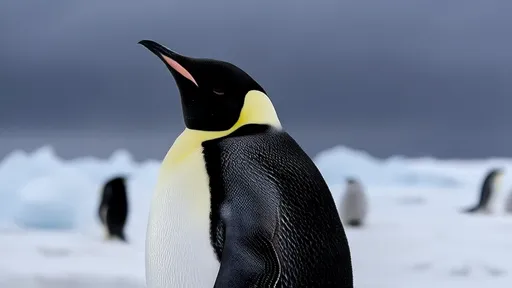
In the vast, frozen expanse of Antarctica, where temperatures plummet to extremes that would be fatal to most life forms, the emperor penguin stands as a testament to evolutionary ingenuity. These flightless birds are not merely surviving; they are thriving in one of the most hostile environments on Earth. Their existence is a masterclass in biological adaptation, a complex symphony of physiological, behavioral, and social strategies honed over millennia. This deep dive explores the multifaceted mechanisms that make the emperor penguin the undisputed survival expert of the Antarctic ice.
The most immediate and obvious challenge is the cold. Air temperatures can dive to a staggering -40°C (-40°F), and wind chill can make it feel far colder. The penguins' first line of defense is their world-renowned plumage. What appears to be a simple tuxedo is, in fact, a highly sophisticated multi-layered insulation system. The outer layer consists of densely packed, overlapping feathers that are highly waterproof. This coating is crucial, as it prevents frigid water from reaching the skin during foraging dives and sheds wind, creating a still layer of air next to the body. Beneath this lies a formidable layer of soft, downy feathers that traps body heat with incredible efficiency. This feathered armor is so effective that emperor penguins can actually overheat on land, a problem they solve by panting, holding their flippers away from their bodies to radiate excess heat, and seeking shade.
Beneath the skin lies another critical adaptation: a thick layer of blubber. This subcutaneous fat can be several centimeters thick and serves a dual purpose. Primarily, it acts as an energy reserve during the long fasting periods of the breeding season, which can last for months. Secondly, and just as importantly, it provides exceptional internal insulation, protecting vital organs from the penetrating cold. This biological wetsuit is a key component of their thermal regulation, ensuring core body temperature remains stable even when external conditions are life-threatening.
Physiology offers even more fascinating secrets. Emperor penguins possess a revolutionary heat exchange system in their limbs known as counter-current heat exchange. Arteries carrying warm blood from the heart run directly alongside veins returning chilled blood from the flippers and feet. In this setup, heat passively transfers from the outgoing arterial blood to the incoming venous blood. The result is that blood reaching the extremities is already pre-cooled, minimizing heat loss to the environment. Conversely, blood returning to the body core is pre-warmed, preventing a dangerous drop in internal temperature. This allows their flippers and feet to operate at temperatures just above freezing, drastically reducing the thermal gradient and thus the rate of heat loss, without risking frostbite or compromising the functionality of these crucial appendages.
Their survival is not a solitary endeavor; it is a collective masterpiece. Perhaps the most iconic image of Antarctic survival is the huddle, or the turtle formation. To withstand the brutal katabatic winds that scream across the ice shelf, thousands of male penguins gather together in a single, massive, rotating swarm. The birds on the windward side, exposed to the full force of the gale, endure the worst of it. The individuals in the center, however, enjoy relative calm and warmth, with temperatures soaring as high as 37.5°C (100°F) inside the huddle. The coordination is remarkable. The entire huddle moves slowly and continuously, with those on the cold outside edges gradually working their way into the warmer center in a constant, life-giving rotation. This ensures that no single bird bears the brunt of the cold for too long, sharing the burden of exposure equally across the colony.
The challenge of reproduction in this frozen world is a saga of extreme endurance. The female lays a single egg in the dead of winter and immediately transfers it to the male's feet before embarking on a long journey to the sea to feed. The male is left with the monumental task of incubating the egg through the darkest and coldest months. He balances it on his feet, covering it with a brood pouch—a warm fold of featherless skin rich in blood vessels. For over two months, he will fast, surviving solely on his fat reserves. He huddles with other males for warmth, losing nearly half his body weight by the time the female returns, just as the chick hatches. This incredible paternal sacrifice is unmatched in the animal kingdom.
Beyond keeping warm, finding food in the frigid Southern Ocean presents its own set of challenges. Emperor penguins are elite divers, capable of plunging to depths of over 500 meters and holding their breath for more than 20 minutes. To achieve this, they have undergone significant physiological changes. Their hemoglobin is specially adapted to efficiently manage oxygen, and they can shut down non-essential organs, directing oxygen and blood flow primarily to the heart and brain. Their solid bones, unlike the hollow bones of flying birds, reduce buoyancy and make deep dives less energetically costly. They prey on fish, squid, and krill, using their exceptional underwater vision to hunt in the near darkness of the deep sea.
The emperor penguin's entire life cycle is a precise dance with the Antarctic environment, timed to the formation and breakup of sea ice. Their resilience is a powerful example of evolution's power. However, this exquisite adaptation to a specific and stable climate is now their greatest vulnerability. The rapid warming of the Antarctic Peninsula and the associated changes in sea ice patterns threaten to disrupt the delicate balance they depend on for breeding and foraging. Conservation efforts are increasingly critical to monitor populations and understand the full impact of a changing climate on these iconic symbols of endurance.
In conclusion, the emperor penguin's ability to conquer the Antarctic cold is not due to one single superpower but a holistic integration of many. It is the combination of their insulative plumage and blubber, their ingenious circulatory system, their unparalleled social cooperation, and their profound physiological adaptations for diving and fasting. They are a perfect package, a marvel of natural engineering built for one purpose: to master the ice. They are not just inhabitants of the Antarctic; they are, in every sense, its ultimate survival experts.

By /Aug 21, 2025
By /Aug 21, 2025

By /Aug 21, 2025
By /Aug 21, 2025
By /Aug 21, 2025
By /Aug 21, 2025
By /Aug 21, 2025
By /Aug 21, 2025
By /Aug 21, 2025
By /Aug 21, 2025

By /Aug 21, 2025
By /Aug 21, 2025

By /Aug 21, 2025

By /Aug 21, 2025

By /Aug 21, 2025
By /Aug 21, 2025

By /Aug 21, 2025
By /Aug 21, 2025
By /Aug 21, 2025

By /Aug 21, 2025
