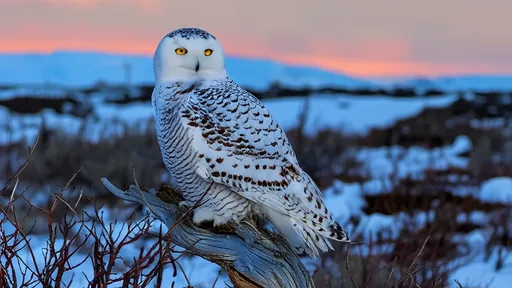
In the vast, silent expanse of the Arctic tundra, where the landscape is a seemingly endless canvas of white, a master of disguise reigns supreme. The Snowy Owl, a creature of mythic beauty and lethal precision, has perfected the art of invisibility. Its brilliant white plumage, often speckled with subtle bars of dark grey or brown, is not merely for show; it is a sophisticated survival tool, a cloak that renders it nearly undetectable against the snow and ice. This is the story of the white world's unseen hunter, a predator whose success is written in the language of light and shadow.
The evolution of the Snowy Owl's iconic coloration is a direct response to its harsh environment. Unlike many owl species that inhabit forests and woodlands, requiring complex patterns of browns and greys to blend with bark and leaves, the Snowy Owl's world is one of stark minimalism. For much of the year, its home is a monochrome panorama of snowdrifts, frozen lakes, and pale skies. Its largely white plumage provides a near-perfect match for this backdrop, a phenomenon known as cryptic coloration. This isn't a static costume; it's a dynamic adaptation. The amount of dark barring on an individual owl can vary, with females and juveniles typically displaying more dark markings than adult males, who can be almost purely white. This variation may offer better camouflage at different times of the year or in slightly different terrains, such as rocky outcrops that break the uniformity of the snow.
This camouflage serves a dual purpose: it is a shield for protection and a veil for predation. To the eyes of potential threats like Arctic foxes or other raptors, a stationary Snowy Owl melds into the scenery, becoming just another undulation in the snow. But the primary function of its invisibility cloak is offensive. The owl is an ambush predator. It employs a patient hunting strategy, often perching on a slight rise—a hummock of earth, a rock, or even a fence post—and scanning the terrain with its incredible eyesight. Its prey, primarily lemmings and other small mammals, are often oblivious to the death that sits in plain sight, mere meters away. The owl's white form breaks up its outline, preventing it from appearing as a distinct, threatening shape against the sky. To a lemming scurrying under the snow or across its surface, the owl above is not an owl at all; it is part of the landscape.
The effectiveness of this disguise is compounded by the owl's profound stillness. It can sit for hours, its body barely registering a breath, its head the only thing moving in imperceptibly slow rotations. This lack of movement is crucial. In an environment where the wind is often the only thing stirring, any sudden motion would instantly betray its position. Its patience is a weapon as sharp as its talons. When it finally decides to strike, the attack is a burst of silent, explosive energy. Its powerful wings, also lined with soft feathers that muffles sound, propel it forward with breathtaking speed. From the perspective of the prey, death arrives from nowhere—a white phantom materializing from the white world.
Beyond its static camouflage, the Snowy Owl's entire physiology is tuned for life in the bright, reflective Arctic. Its eyes are a striking yellow, set in a facial disc that helps funnel sound to its ears, but they are also adapted to handle the extreme light conditions. The Arctic summer brings the midnight sun, weeks of continuous daylight, while the winter plunges the land into prolonged darkness. The owl's eyes are highly efficient at capturing available light, allowing it to hunt effectively during the dark winter months and the dim twilight that passes for night in the summer. Even its feet are feathered, great white boots that provide insulation against the frozen ground and complete the head-to-toe white ensemble.
However, the owl's camouflage is not infallible, and its life is one of constant calculation. The changing seasons present a challenge. During the brief Arctic summer, when the snow recedes to reveal a patchwork of brown earth, green moss, and grey rock, the pristine white owl can become surprisingly conspicuous. During these periods, they often rely even more heavily on their immobility and may choose perches that still offer some white background, such as a remaining snow patch or a pale rock. This seasonal vulnerability highlights the specialization of their adaptation; they are truly creatures of the snow.
Furthermore, the success of this "invisible hunter" is intrinsically linked to the health of its ecosystem. The camouflage of the Snowy Owl is a masterpiece of evolution, refined over millennia to fit a specific, stable environment. The growing threat of climate change, which is warming the Arctic at an accelerated rate, poses a profound risk. Earlier snowmelts and later freezes extend the periods where the owl's brilliant white is a liability rather than an asset. This mismatch between an animal's adaptation and its rapidly altering environment is a silent crisis, potentially hampering its ability to hunt effectively and avoid predators.
Observing a Snowy Owl in its natural habitat is an experience of sudden revelation. You scan the white plain, seeing nothing but snow and sky. Then, a shift in perception occurs—a shape resolves itself, a detail clicks into place, and the ghostly form of the owl appears where a moment before there was emptiness. It is a humbling reminder of nature's genius for design. The Snowy Owl does not hide in burrows or dens; it hides in the open, using the very substance of its home as a garment. It is the epitome of Arctic adaptation, a silent, white specter whose greatest trick is to make itself disappear, proving that in the ruthless game of survival, sometimes the most powerful thing to be is unseen.
By /Aug 21, 2025
By /Aug 21, 2025
By /Aug 21, 2025
By /Aug 21, 2025
By /Aug 21, 2025
By /Aug 21, 2025
By /Aug 21, 2025
By /Aug 21, 2025
By /Aug 21, 2025
By /Aug 21, 2025
By /Aug 21, 2025
By /Aug 21, 2025
By /Aug 21, 2025
By /Aug 21, 2025
By /Aug 21, 2025
By /Aug 21, 2025

By /Aug 21, 2025
By /Aug 21, 2025

By /Aug 21, 2025
By /Aug 21, 2025
